
The Secret Code of Feeling: The Empfindsamer Stil (Key Stage 4+)
Imagine a time when all music was grand, complicated, and strictly organized—a bit like an architect's blueprint. That was the Baroque era! But in the mid-1700s, composers in Germany decided they wanted music to be less about rules and more about feelings.
They invented a style called the Empfindsamer Stil, which translates to the "Sensitive Style." Think of it as music's first serious attempt to capture the moment-to-moment, often unpredictable, emotions of an individual person. It was all about being immediate and dramatic.
What Makes Music Empfindsamer Stil or "Sensitive"?
This style has a few musical "tells" that you can listen out for:
Emotional Rollercoaster: The music doesn't stay happy or sad for long. There are sudden, abrupt changes in volume (loud to quiet) and mood.
Stop-Start Rhythms: Unlike the continuous flow of earlier music, the Sensitive Style uses unexpected rests, pauses, and broken rhythms, like someone is interrupting themselves while speaking.
Melody is King: The tunes are highly expressive, often sounding like someone is having an intense, private conversation or monologue.
Spicy Harmonies: Composers used slightly uncomfortable or unexpected chords (called dissonances and chromaticism) to make the listener feel uneasy, anxious, or deeply yearning.
Spotlight on the Master of Feeling: C.P.E. Bach
The most important composer for the Sensitive Style was Carl Philipp Emanuel Bach (or C.P.E. Bach). He was the son of the famous J.S. Bach, but his music sounds completely different! He truly believed that music should express the soul's turmoil.
C.P.E. Bach's Solfeggietto in C minor
This piece is a short, incredibly fast (Prestissimo) keyboard work that perfectly captures the style.
Solfeggietto means "little solfege exercise," which suggests it's just a warm-up. But listen to it! It's a frantic, breathless burst of notes.
Feature | How It Feels | Connection to the Sensitive Style |
Tempo | Very Fast (Prestissimo) | Creates an immediate sense of urgency and anxious energy. |
Key | C minor | Historically linked to serious, passionate, or dramatic emotions. |
Texture | Fast runs, jumping between hands | Emphasis the Empfindsamer Stil's focus on sharp, expressive melodic movement. |
The music sounds like a flurry of nervous energy, a perfect snapshot of a highly intense feeling.
Three Other Sensitive Piano Pieces
The influence of this emotional style spread quickly and acted as a bridge from the complicated Baroque era to the more balanced Classical era (think Mozart and Haydn).
Here are three more examples of the Sensitive Style for the keyboard:
C.P.E. Bach: Fantasia in F-sharp minor
A Fantasia is a piece where the composer has maximum freedom—no rules! This piece is the ultimate emotional journey. It includes passages that sound exactly like an actor delivering a dramatic speech (recitative). It's full of unpredictable stops, starts, and jarring harmonies, demanding that the performer and listener follow the composer's intense personal mood.
Wilhelm Friedemann Bach: Polonaise No. 8 in E minor
Wilhelm Friedemann was another one of J.S. Bach's sons. While a Polonaise is traditionally a stately Polish dance, W.F. Bach turns it into something melancholic and dramatic by using a minor key. Listen for the dynamic changes (loud, soft, loud again) and the sudden bursts of expression. It sounds like a structured dance on the surface, but with a deep, emotional sadness bubbling underneath.
Johann Gottfried Müthel: Duetto in E-flat major for Two Keyboards
Müthel was a pupil of J.S. Bach and an admirer of C.P.E. Bach, making him a central figure in the Sensitive Style. This Duetto is known for its extreme contrasts and virtuosic writing, pushing the keyboard to its limits. Look for the wildly contrasting moods that can shift from grand declarations to quiet, introspective sighs in just a few bars. Müthel uses the sudden shifts in rhythm and texture to give the music a spontaneous, almost improvised feeling, characteristic of Empfindsamer Stil's dramatic individualism.
Empfindsamer Stil could be known as ‘The Soloist's Soliloquy’. It was deeply tied to the Clavichord, an instrument so quiet it was virtually inaudible in a public hall. It was music meant for a room of one, or perhaps two. Because the player could feel the string directly through the key, the "melancholy" was tactile and internal. It’s the sound of someone thinking out loud—capricious because thoughts are non-linear where the focus is on the minutiae of the protagonist's feelings.
In the earlier Galant style, the harmony changed slowly and predictably. To achieve that "avalanche" effect there was an increased frequency of non-chord tones (suspensions and appoggiaturas) to create a constant sense of yearning.
The Clavichord as a Mirror
To truly understand Empfindsamer Stil, we have to look at the Clavichord, the instrument they were written for. Unlike the Harpsichord (which is "all or nothing") or the Pipe Organ (which is "architectural"), the Clavichord is microscopic.
Feature | Impact on Empfindsamer Stil |
Bebung | A vibrato achieved by rocking the finger on the key. This is "tactile emotion." |
Tangents | The metal piece stays in contact with the string, allowing the player to "feel" the sound’s vibration until it dies. |
Dynamic Range | Extremely quiet. It demands a "solitary listener," much like reading a private letter in a Richardson novel. |
Harmonic Language
You will find in a piece written in The Empfindsamer Stil style
Chiaroscuro effects: Rapid shifts between major and minor.
The "Seufzer" (Sigh): Frequent use of descending chromatic figures to mimic human weeping or longing.
Unexpected Modulations: Using harmony to represent the erratic nature of human feeling rather than just formal structure.
Physicality and Performance
In Empfindsamer Stil, the Clavichord was the preferred instrument because its Bebung (vibrato) allowed for a physical connection between the player's touch and the sound.
Philosophical Roots
Empfindsamer Stil grounded itself in the idea of Originalgenie (original genius). They moved away from the Baroque "Doctrine of the Affections" where one movement represented one static emotion toward a model where music reflects the fluidity of the human soul.
The philosophical shift coincided with the 1740 publication of Pamela; or, Virtue Rewarded by the English author Samuel Richardson. This novel is an example of an epistolary novel, meaning an intimate story told through a series of letters, a form that helped give the reader intimate access to the character's inner life and feelings, thereby promoting the novel's focus on individual psychology.
Empfindsamer Stil wasn't just a passing musical fad, but part of a pan-European "Cult of Sensibility." The connection demonstrates that the entire culture was moving toward a more fragmented, psychological way of expressing the self.
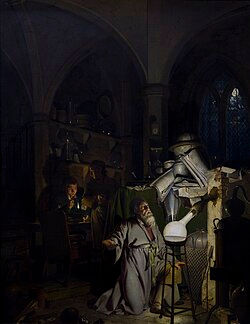
This can be seen to great effect in The Alchymist in Search of the Philosopher’s Stone, (1771) by Joseph Wright of Derby. Just as the artist used Chiaroscuro to pull light out of darkness, C.P.E. Bach used sudden harmonic shifts to illuminate the 'inner weather' of the human soul. The "explosive" nature of the light in this painting can help with a visualisation of the "frantic and breathless" quality heard or played in the Solfeggietto in C minor. In the 1913 edition published by St. Louis: Art Publication Society (Available from IMSLP please see reference list) the Solfeggietto is paired with a piece called Allegro di Molto. This piece is famous for its wide interval leaps and sudden pauses. These can be compared to the musical "shocks" in the same way the light in The Alchymist catches only specific edges of the room, a hand, a glass flask, a startled face. This series of emotional flashes is presented instead of gradual illumination, leaving the rest in mystery.
In the Allegro di Molto that we see the full 'Chiaroscuro' of C.P.E. Bach’s genius. Here, the music stops being a simple sprint and becomes a psychological landscape, where jagged melodic leaps and sudden silences mirror the explosive, flickering light of a Wright of Derby canvas or the frantic, intimate prose of an 18th-century epistolary novel.
Listening Note: To hear this 'Sensitive Style' at its most volatile, listen to the Allegro di Molto alongside the Solfeggietto. Where the Solfeggietto is a breathless sprint, the Allegro di Molto is a psychological storm.
A Bridge to the "Avalanche"
For students studying Advanced theory it will be beneficial to listen to the "Prussian" Sonatas or "Württemberg" Sonatas by C.P.E. Bach. They are the structural bridge where the "introspective" keyboard style begins to adopt the larger, more dramatic gestures that would eventually trigger the Sturm und Drang symphonies of the next generation and the arrival of the Manheim Rocket in the next article of this series.
Test Your Knowledge: The Sensitive Style
Which of the following is NOT a defining characteristic of the Empfindsamer Stil (Sensitive Style)?
Continuous, flowing rhythms with minimal pauses.
Sudden, abrupt changes in volume and mood (Chiaroscuro effects).
The use of dissonant or "spicy" harmonies.
Melodies that sound like an intense, private monologue.
C.P.E. Bach's Solfeggietto in C minor is described as frantic and breathless. Which musical term best captures this urgency?
Adagio
Andante
Prestissimo
Largo
The Empfindsamer Stil was deeply connected to the Clavichord. What specific technique was possible on the Clavichord that allowed the performer to create a "tactile emotion" or vibrato?
Arpeggio
Bebung
Tremolo
Sforzando
Glossary of Terms
Term | Definition |
Bebung | A type of vibrato effect achievable only on the Clavichord by rocking the finger on the key, allowing for a minute and tactile fluctuation in pitch and volume, central to the Empfindsamer Stil. |
Baroque | The musical period (approx. 1600–1750) preceding the Empfindsamer Stil, characterized by complex polyphony, strict structures, and the Doctrine of the Affections. |
Chiaroscuro | In music, the rapid and dramatic contrast between loud/soft (dynamics) or major/minor (harmony), mirroring the light/dark effects in painting. |
Chromaticism | The use of notes outside the key (sharps and flats) to create tension, yearning, or a "spicy" harmonic effect. |
Clavichord | A quiet, intimate keyboard instrument preferred during the Empfindsamer Stil due to its ability to control dynamics and produce Bebung. |
Doctrine of the Affections | The Baroque idea that an entire movement should represent one single, stable emotion (affect). The Empfindsamer Stil moved away from this. |
Empfindsamer Stil | German for "Sensitive Style," a mid-18th-century movement focused on expressing immediate, unpredictable, and highly personal emotions. |
Epistolary Novel | A novel written as a series of documents (typically letters), a literary form that mirrored the Empfindsamer Stil's focus on intimate, internal psychological life. |
Galant Style | A light, elegant, and decorative style that co-existed with the Empfindsamer Stil and preceded the Classical era. |
Originalgenie | German for "Original Genius," an Enlightenment-era philosophical concept celebrating the artist's unique, inspired, and rule-breaking creativity, which fueled the emotional intensity of the Sensitive Style. |
Prestissimo | A musical tempo marking indicating an extremely fast speed. |
Seufzer | German for "sigh," a musical motif—often a descending two-note figure—used to evoke human weeping or longing, characteristic of the Empfindsamer Stil. |
Sturm und Drang | German for "Storm and Stress," a late-18th-century proto-Romantic movement that intensified the dramatic, turbulent, and subjective qualities of the Empfindsamer Stil. |
Reference list
Agbenyo, S. (2021). ‘Empfindsamer Stil’ and Its Literary Connections: a Cue to Music Instruction. British Journal of Contemporary Education, 1(1), pp.109–119. doi:https://doi.org/10.52589/bjce-lnpbmki0.
Caton-Greasley, C. (2026). The Doctrine of the Affections: Music and Emotion in the Baroque Era. [online] Staly Music Academy. Available at: https://www.stalybridgemusicacademy.com/post/the-doctrine-of-the-affections-music-and-emotion-in-the-baroque-era [Accessed 6 Apr. 2026].
Franks, J. (2023). Defining Techniques: the Use of Chiaroscuro in Art. [online] Blue & White Company. Available at: https://www.blueandwhitecompany.com/journal-entry/defining-techniques-the-use-of-chiaroscuro-in-art [Accessed 6 Apr. 2026].
Graves, R. (2025). Age of Extremes Sympathetic to Empfindsamer Stil. [online] Charlottesville Classical. Available at: https://www.charlottesvilleclassical.org/posts/age-of-extremes [Accessed 6 Apr. 2026].
Huebner, K. (n.d.). Comparisons of Perspective: Empfindsamer Stil as A…. [online] Music & Practice. Available at: https://www.musicandpractice.org/volume-2/empfindsamer-stil-a-microcosm-of-cultural-change/ [Accessed 5 Apr. 2026].
IMSLP & CPE Bach (1766). Solfeggio in C minor, H.220 (Bach, Carl Philipp Emanuel). [online] Imslp.org. Available at: https://imslp.org/wiki/Solfeggio_in_C_minor,_H.220_(Bach,_Carl_Philipp_Emanuel) [Accessed 6 Apr. 2026].
Richardson, S. (2004). Pamela, or Virtue Rewarded. [online] Available at: http://public-library.uk/pdfs/8/646.pdf [Accessed 5 Apr. 2026].
Seaton, D. (2017). Ideas and Styles in the Western Musical Tradition. [online] New York: Oxford University Press. Available at: https://global.oup.com/us/companion.websites/9780190246778/student/ch16/ [Accessed 6 Apr. 2026].
Wikipedia Contributors (2023). The Alchemist Discovering Phosphorus. [online] Wikipedia. Available at: https://en.wikipedia.org/wiki/The_Alchemist_Discovering_Phosphorus [Accessed 6 Apr. 2026].
Xiao, J. (2024). Exploring the Aesthetic of Empfindsamer Stil: A Case Study on Carl Philipp Emanuel Bach’s Keyboard Sonata in A Major, Wq55 No.4’s Second Movement. Transactions on Social Science Education and Humanities Research, 7, pp.433–437. doi:https://doi.org/10.62051/pz98cg87.

