
Understanding Stage 1 'Stave Furniture'. A Reading Skill (Key Stage 2)
Focus Skill: Stave Furniture
Keywords: Stave, Bar, Barline, Clef, Time Signature.
Skill - Reading Skill: Identification of foundational music symbols.
Music is a language made up of symbols that tell musicians what to play and how to play it. For Key Stage 3 students, learning to read these symbols is an important step in understanding music. This post explains some of the most common music symbols you will encounter: the stave, bar, barline, treble clef, bass clef, and time signature. Knowing these will help you read music more confidently and enjoy playing or singing songs.
Reading Skill
What Is a Stave?

The stave (sometimes called staff) is the foundation of written music. It consists of five horizontal lines and four spaces between them. Each line and space represents a different musical pitch. Notes are placed on the lines or in the spaces to show which sound to play.
The bottom line is the lowest pitch.
The top line is the highest pitch.
Notes can also go above or below the stave using small extra lines called ledger lines.
Think of the stave as a musical ladder. Each step up or down changes the note you play. Without the stave, notes would have no place to sit, and music would be hard to read.
Understanding Bars and Bar lines
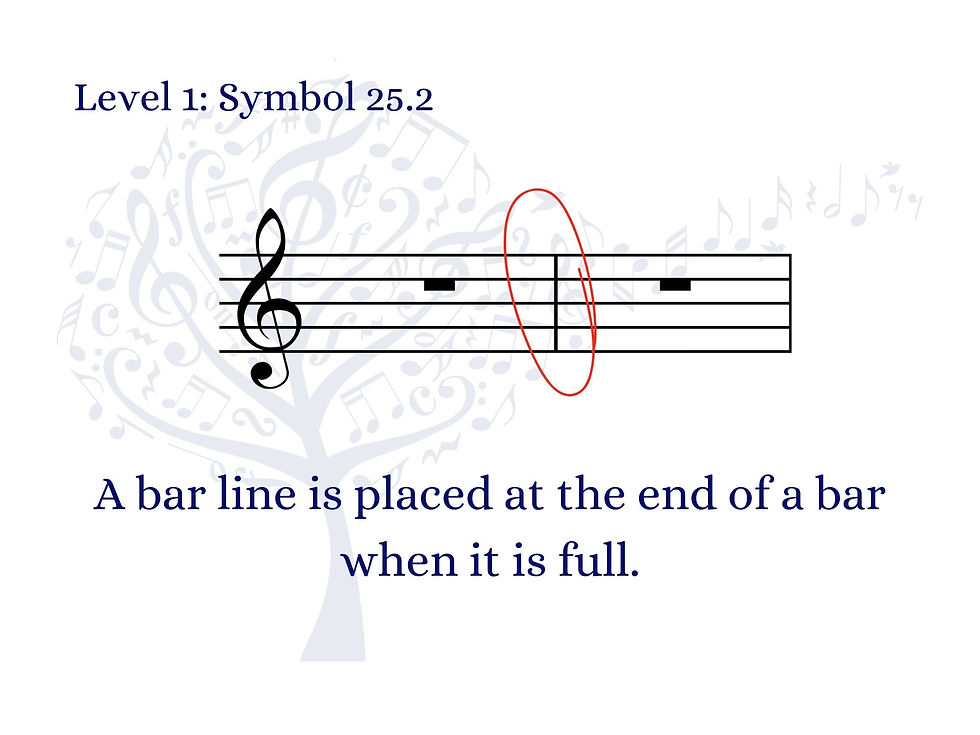
Music is divided into sections called bars (or measures). Bars help organize music into manageable chunks, making it easier to follow the rhythm.
A barline is a vertical line that cuts through the stave.
Barlines mark the end of one bar and the start of the next.
Each bar contains a set number of beats, depending on the time signature.
For example, if a piece has four beats per bar, each bar will hold notes and rests that add up to four beats. Bars help musicians keep time and stay together when playing in groups.
The Treble Clef Explained

The treble clef is one of the most common clefs in music. It looks like a fancy letter "G" and is sometimes called the G clef because it circles around the second line of the stave, which represents the note G.
The treble clef is used for higher-pitched instruments and voices, such as the violin, flute, or soprano singers.
It tells you that the notes on the stave are higher in pitch.
When you see the treble clef at the start of a piece, you know the music is written for higher sounds. For example, the note on the bottom line of the treble clef stave is E, and the note on the top line is F.
The Bass Clef and Its Role

The bass clef looks like a backward "C" with two dots beside it. It is also called the F clef because it marks the fourth line of the stave as the note F.
The bass clef is used for lower-pitched instruments and voices, such as the cello, bass guitar, or bass singers.
It shows that the notes on the stave are lower in pitch.
If you play the piano, the left hand usually reads music written in the bass clef. The bottom line of the bass clef stave is G, and the top line is A.
What Does the Time Signature Mean?
2 crotchet beats per bar 3 crotchet beats per bar 4 crotchet beats per bar
The time signature appears at the start of a piece of music, right after the clef. It looks like two numbers, one on top of the other, like a fraction but without the line.
The top number tells you how many beats are in each bar.
The bottom number tells you what kind of note gets one beat.
For example, a time signature of 4/4 means there are four beats in each bar, and a quarter note gets one beat. This is the most common time signature and is sometimes called "common time."
Other examples include:
2/4 time: two beats per bar, a crotchet or quarter note gets one beat (marching rhythm)
3/4 time: three beats per bar, a crotchet or quarter note gets one beat (like a waltz)
42/4 time: four beats per bar, a crotchet or quarter note gets one beat (pop rhythm)
Understanding the time signature helps you count the rhythm and play music with the right timing.
Putting It All Together
When you look at a piece of music, you will see the stave with five lines and four spaces. At the beginning, you will find a clef symbol, either treble or bass, which tells you the pitch range. Next to the clef is the time signature, which tells you how to count the beats in each bar. Vertical bar-lines divide the music into bars, helping you keep track of the rhythm.
Tips for Remembering Music Symbols
Think of the stave as the musical grid where notes live.
Remember barlines as fences that divide the music into sections.
The treble clef looks like a fancy G and is for high sounds.
The bass clef looks like a backward C and is for low sounds.
The time signature is your rhythm guide, telling you how to count beats.
Practice by looking at sheet music for your favorite songs or simple pieces. Try to spot these symbols and say what they mean. Over time, reading music will become easier and more natural.


