
Compose a Shanty with a Dorian Anchor (Key Stage 2)
Updated: Jun 2
Time to set sail! We are going on a mysterious journey on the legendary ship The Modal Memoria. Some say it is a ghost ship from the age of the Modal Masters, and it can only be seen by students who can play the old sounds with a true heart.
It docks from The Enchanted Kingdom on a weekly basis; if we have your Sea Shanty ready, you may be able to get onboard. You have to sing or play a new shanty to board the ship. I think the next mooring is due soon.
Are you ready to learn how to compose a Sea Shanty?
1. The Sailor’s Secret: Finding the Dorian Anchor
The first task is to send out a call to The Modal Memoria. For this, we need an ancient musical secret. An old ‘salty’ Music Maestro told me this secret when I was lingering on the shores of ‘The Deep’ in the Enchanted Kingdom many years ago!

On your piano or keyboard, find the Anchor note D4, then play all the natural (white) notes from D4 up to D5. Use the exact same finger pattern you use for a C major scale.
Hint: In the right hand, the pattern going up from D4 would be 1-2-3, then tuck your thumb under to play 1-2-3-4-5. Coming back down from D5, it is 5-4-3-2-1, then cross your middle finger over to finish 3-2-1.
Remember: Tuck your thumb under just after you play the F on the way up!
Did you notice how this mode sounds mysterious and a little ‘salty’?
However, there is a breezy and dancing character because it has a B natural, and not the B-flat you would find in a standard D minor scale.
Play the two scales together and listen for the difference! When you "forget" the B-flat in D minor, it is not a wrong note at all, it simply means you are playing the Dorian mode instead of D natural minor.
(By the way, another name for D natural minor is the D Aeolian mode, it is another ancient sound.)
2. The Golden Rule: Call and Response (The 8-Bar Map)
Every adventure needs a treasure map, and on The Modal Memoria, it is a musical treasure map!
The structure of our shanty is split into two simple parts: the Captain's Call and the Crew's Response. To draw your map, you will need an eight-bar stave grid. You can download a copy below or draw eight bars in your manuscript book.
Bars 1–2 (The Call): The Captain steps up and asks a musical question. Start on your Anchor note (D) but explore the notes around it to create a short, catchy tune.
Bars 3–4 (The Response): The crew answers! They sing back, but they leave the final melody hanging on an "unfinished" note like A. This shows the crew that the voyage isn't over yet.
Bars 5–6 (The Call Repeated): The Captain repeats the exact same question from Bars 1–2 to build the crew's confidence.
Bars 7–8 (The Final Response): The crew answers one last time. This time, the melody must drop firmly back down to the Anchor note (D) to safely dock the ship in harbour.
Here is an example.
3. Chanting the Rhythms First
Before we choose our notes on the piano, we need to drop a steady rhythmic anchor. Sea shanties are work songs, which means the words must have a strong, predictable pulse to help the sailors pull the ropes together.
Every line of our shanty needs a clear rhythm. To help you map out your words, we are going to use a Rhythm Box Grid in simple quadruple time.
The Shanty Maker's Rhythm Map (Example)
Here is an example of how you can turn words into an exciting sea shanty rhythm using some of your favourite note values.
The Captain's Call (Bars 1–2)
Bar 1: "Pull the heavy ropes along!"
Rhythm: Two-Quavers, Two-Quavers, Two-Quavers, Crotchet.

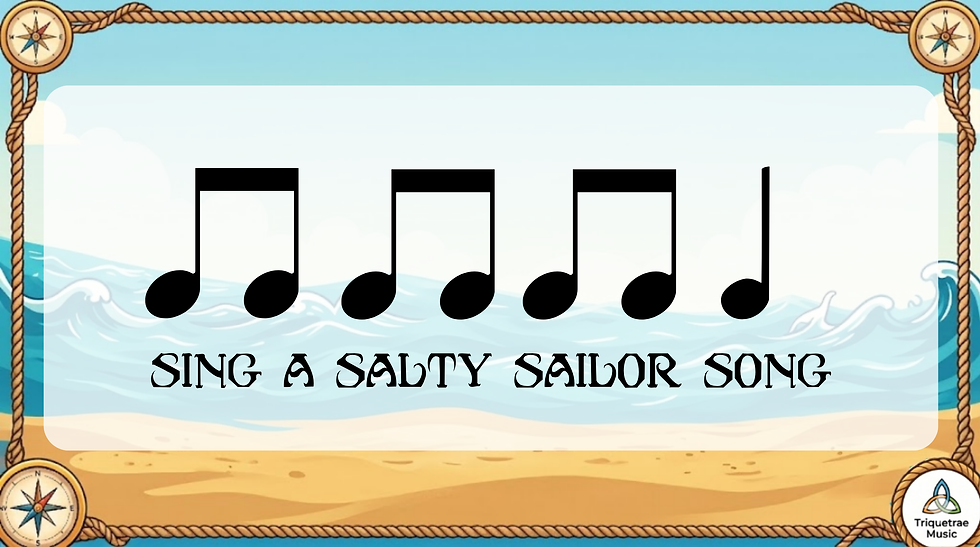
Bar 2: "Sing a salty sailor song!"
Rhythm: Two-Quavers, Two-Quavers, Two-Quavers, Crotchet.
The Crew's Response (Bars 3–4)
Bar 3: "Heave-ho, pull together!"
Rhythm: Crotchet, Crotchet, Two-Quavers, Two-Quavers.

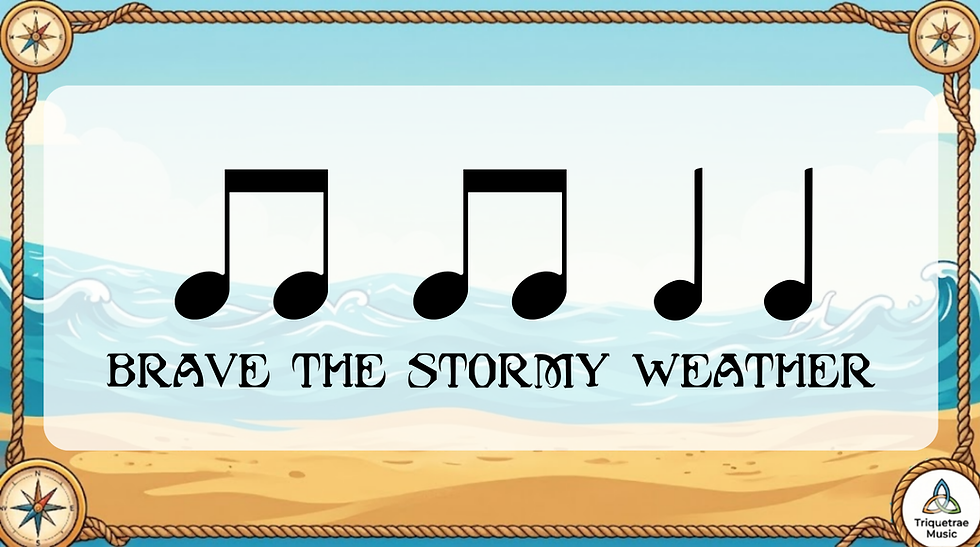
Bar 4: "Brave the stormy weather!"
Rhythm: Two-Quavers, Two-Quavers, Crotchet, Crotchet.
Remember: For Bars 5–6, the Captain repeats the rhythm and words from Bars 1–2, and then the crew makes up a final response for Bars 7–8 to land safely on a long semibreve D.
4. Your Turn: Step-by-Step Format
To write your own, follow this simple blueprint:

Write your words first: Think of a 4-line poem about the sea, ghost ships, or pulling ropes.
Clap the pulse: Clap a steady 4-beat count and chant your words over the top. Which words feel short? Which words feel long?
Fill in your Rhythm Boxes: Draw 4 boxes on a piece of paper (one for each bar). Fill each box with exactly 4 beats worth of notes that match your words. You can use:
Semibreves for a long, calm sea
Minims or Crotchets for a steady march
Quaver pairs for a fast, splashing wave
Dotted Crotchet + Quaver to give your shanty a true nautical skip!

⚓ The Master’s Challenge ⚓
Want to impress the Modal Masters? Complete the ultimate challenge by adding a steady D and A drone in your left hand.
Play D3 (with finger 5) and A3 (with your thumb) together on the very first beat of every single bar to guide your melody home.
5. Action Call: Ready to Board?
Are you ready to board?
Grab your manuscript paper, head to the piano, and find your Dorian Anchor. Now try out your sea shanty on the piano and write it down carefully. When you are happy with how it sounds, record your sea shanty and send it across to your teacher.
Bring your completed shanty to your next lesson to receive your official boarding pass for The Modal Memoria!

Where will our musical voyage travel to next?
Multiple Choice Questions for Key Stage 2 Sailors
Answer the questions in your Music Journal and show your teacher at the next lesson.
1 . What is the special note you must use as your 'Dorian Anchor'?
a. C4
b. G5
c. D4
d. F natural
2 . A D Dorian mode is different from a D natural minor scale because the D Dorian mode has what note?
a. A B-flat
b. A C sharp
c. A G flat
d. A B natural
3 . What are the two main parts of the musical 'treasure map' (the 8-Bar Map)?
a. Verse and Chorus
b. Captain's Call and Crew's Response
c. Loud and Quiet
d. Bar 1 and Bar 8
Glossary for Key Stage 2 Sailors
Sea Shanty: A type of work song that sailors used to sing to help them pull ropes and work together.
Dorian Mode: A mysterious-sounding musical scale that starts on the note D and uses only white notes, making it sound different from a standard minor scale.
Anchor Note: The most important starting note (D4) of a musical scale that holds the shanty together.
Call and Response: A musical structure where one person (the Captain) sings a short musical question, and a group (the Crew) sings a short answer back.
Drone: A steady, repeated musical note or notes (like D and A) played in the background to guide the melody.
Crotchet (♩): A note value that lasts for one beat.
Quaver (♫): A faster note value that lasts for half a beat (you need two quavers to make one Crotchet beat).
