Musical Messages: A Beginner's Guide to Bugle Calls (Key Stage 1)
Updated: Jun 2
Have you ever wondered how people talked to each other in big camps before phones were invented? They used music as a secret code!
What is a Bugle?
A bugle is a shiny brass instrument that looks like a trumpet. But there is one big difference: a bugle has no buttons!.
Because it has no buttons, the person playing has to use their breath and their lips to make different sounds. This makes the bugle very simple and very loud.
Feature | The Bugle | The Trumpet |
Buttons | None! | Usually three buttons |
What it does | Sends quick signals | Plays long, pretty songs |
Why Use Music to Talk?
Imagine a busy, noisy park. If you tried to shout to your friend on the other side, they might not hear you. But a bugle is perfect for sending messages because:
It is LOUD! You can hear it from very far away, even if it is windy.
It is SIMPLE! The tunes are short so everyone can remember what they mean.
It is CLEAR! Each song means just one thing, like "Time to Eat!".
The Three Magic Notes
Because a bugle has no buttons, it can only play a few special notes. Musicians usually use a group of three notes called a triad. Every famous bugle call you hear is made using just these three magic notes jumping up and down.
Famous Bugle Calls to Listen For
There are many different calls, but here are two you might know:
1. Reveille (The "Wake Up" Song)
This is a happy, fast song played early in the morning. It tells everyone, "Get out of bed and get moving!". The name comes from a French word that means "to wake up".
2. Taps (The "Sleepy" Song)
This song is very slow and peaceful. It only uses three notes to tell everyone it is time to
go to sleep. It is also used to say a quiet, respectful goodbye.
Your Musical Mission
Now it is your turn to be a composer! Can you think of a secret message to send with music?
Choose a Message: Maybe it is "Dinner is ready" or "Time to tidy up!"
Pick Three Note Pitches: Use three notes of the a triad like C, E, G of C major.
Make a Rhythm Note Pattern: Use your Rhythm Notes to make a pattern of crotchets, minims, dotted minims and semibreves.
Make the Call: Add a 'Note Pitch' to a 'Rhythm Note' and sketch it out in your Music Journal.
Time to Play: Play the Call and give it a name.
Write it Out: When you are happy with it write it in your Manuscript Book
Video & Show Your Teacher: Video your call for your Music Portfolio and send that, and a photo of your music Journal page to be added to your Stage 1 Portfolio.
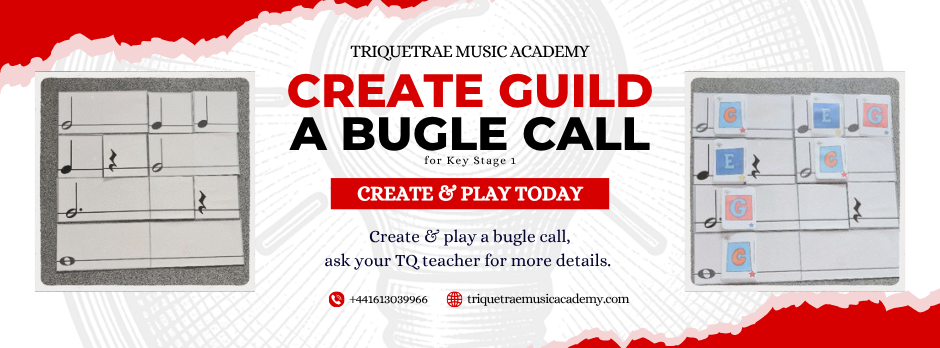
You have just made your very own bugle call. Create a weeks worth of Bugle Calls to become a TQ Bugle
Quiz Time.
Answer the questions on the video with a grown-up then write the answers in your Music Journal. A reminder of the questions is shown below.
Question 1: What is the biggest difference between a bugle and a trumpet?
A) The bugle is much heavier.
B) The bugle has no buttons.
C) The bugle is always red.
Question 2: Why is a bugle good for sending messages?
A) It is very quiet.
B) It can play long, complicated songs.
C) It is LOUD and simple.
Question 3: Which bugle call is played to tell everyone to "Wake Up!"?
A) Taps (The "Sleepy" Song)
B) Reveille (The "Wake Up" Song)
C) Dinner Call
Key Stage 1 Glossary for Parents
Bugle: A simple brass instrument, like a trumpet, but it has no buttons, which makes it good for quick, loud messages.
Trumpet: A brass instrument that is more complex than a bugle because it usually has three buttons, allowing it to play long, complicated songs.
Buttons: Small valves on an instrument (like a trumpet) that a musician presses to change the notes. The bugle does not have these.
Signal/Message: A short, clear piece of music used to tell people what to do, like "time to eat".
Triad: A special group of three notes that musicians use to create all the famous bugle calls.
Reveille: (Pronounced: Re-va-lee) A happy, fast bugle call that means "Wake Up!".
Taps: A slow, peaceful bugle call used to mean "Time to sleep" or a quiet goodbye.