The Key to the Notes: Clefs (Key Stage 2)
Have you ever seen the five lines where music is written? That's called the stave or the staff!
At the very start of the stave, there is a special symbol called a clef (say 'kleff'). A clef is like a secret key that tells your eyes exactly which note is which on the lines and spaces. Without the clef, you wouldn't know if a note was high or low!
Where did the word 'Clef' come from?
The word 'clef' is from a very old Latin word, Clavis, which means 'key'!
Long, long ago, music experts thought the clef was the literal key to unlocking the meaning of the music written on the page.
The very first clef was simple! It was just the letter 'F' written on one red line of the staff.
The Two Most Popular Clefs
Today, we use two main clefs all the time. Can you learn their names and what they do?
Clef Name | What it looks like | What it's for | Why it has its name |
Treble Clef Below on the right. | A big, fancy, curly shape (like the letter G) | High notes (like a flute, a singer's high voice, or the right hand on a piano) | It is also called the G Clef because the middle curl of the shape wraps right around the line where the note G lives. |
Bass Clef Below on the left. | A shape that looks a little like a half-heart with two dots | Low notes (like a cello, a singer's deep voice, or the left hand on a piano) | It is also called the F Clef because the two dots sit on either side of the line where the note F lives. |
Bass Clef Treble Clef
The Story of the Five Lines
When music was mostly just singing, people only needed three or four lines on the stave, because singers only have a certain range of notes.
But then, people started making lots of different musical instruments! These instruments could play notes much higher and much lower than a voice. To fit all these new notes, composers needed more lines!
Slowly, over many years, the stave was changed and fixed until it became the standard five lines we use today. This five-line stave became standard by the 14th century, especially for music where many different melodies play at the same time (called polyphonic music).
The next time you see a Treble Clef or a Bass Clef, you will know that it is a 'key' that unlocks centuries of musical history!
Clef Practice Time!
Ready to draw your own keys to music? You can practice drawing the clefs on the worksheets below.
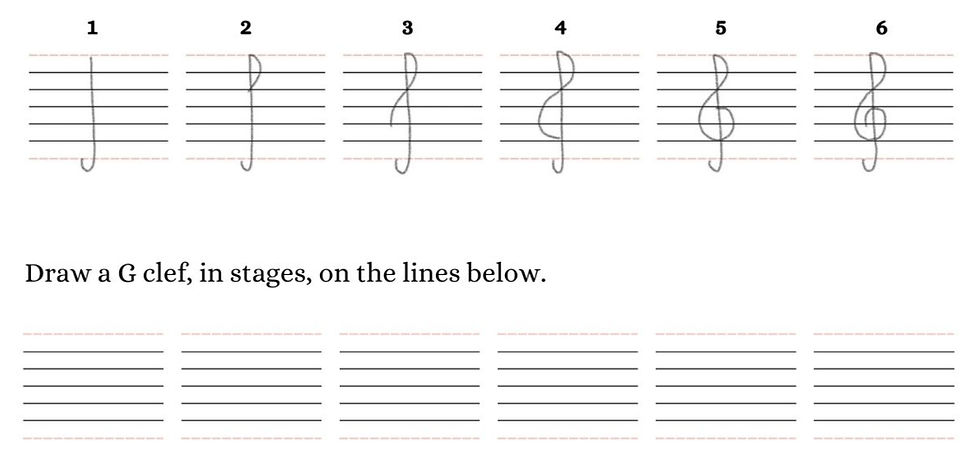
F Clef Worksheet: Use the practice staff lines here to make your clefs perfect. G Clef Worksheet: This document has a step-by-step guide and practice lines.
G Clef Worksheet (above right): This document has a step-by-step guide and practice lines.
F Clef Worksheet (above left): Use the practice staff lines here to make your clefs perfect.
Download the Worksheets as a PDF below.
Quiz Time!
Write the answers in your Music Journal and take them to your lesson to show your teacher.
What is the name for the five lines that music is written on?
What is a clef, and what is its job?
The word 'clef' comes from the Latin word Clavis. What does Clavis mean?
Which of the two main clefs is used for high notes?
Why is the Bass Clef also called the F Clef?
Glossary of Musical Terms (Key Stage 2)
Term | Meaning |
Stave (or Staff) | The set of five horizontal lines and four spaces on which musical notes are written. |
Clef (say 'kleff') | A special symbol placed at the beginning of the stave that tells you which notes are on which lines and spaces. It is the 'key' to reading the music. |
Treble Clef | The clef used for high notes (like a flute or piano right hand). It is also called the G Clef. |
Bass Clef | The clef used for low notes (like a cello or piano left hand). It is also called the F Clef. |
Note | A symbol that represents a musical sound, telling you how high or low the pitch is, and how long the sound lasts. |
Pitch | How high or low a sound is. |
Clavis | The Latin word meaning 'key', from which the word 'clef' comes. |
Polyphonic | Music where many different melodies or voices play at the same time. |