
The Harpsichord: The Grandparent of the Piano (Key Stage 2)

Imagine a keyboard instrument that looks a little like a grand piano, but sounds very different!
That's the harpsichord.
What was it?
The harpsichord is an instrument from a long time ago. It has a keyboard, just like a piano, but when you press a key, instead of a hammer hitting a string (like in a piano), a tiny piece called a plectrum plucks the string. Think of it like a guitar pick plucking a guitar string, but inside the instrument.
This plucking action gives the harpsichord its special, bright, and slightly "twangy" sound.
Part | What it Does |
Key | You press this to play a note |
String | This makes the sound |
Plectrum | This tiny part plucks the string |
Soundboard | This makes the sound loud enough to hear |
Explainer Video
When was it used?
The harpsichord was very popular for around 300 years! It was first used a lot during the Renaissance period and became the most important keyboard instrument during the Baroque period.
Famous composers like Johann Sebastian Bach and George Frideric Handel wrote lots of amazing music for the harpsichord. If you listen to music from the 16th, 17th, and 18th centuries (that's the 1500s to the 1700s), you will hear the harpsichord everywhere!
It started to become less popular around the time the piano was invented, in the late 18th century, but people still love playing and listening to it today!
Harpsichord vs. Piano: What's the difference?
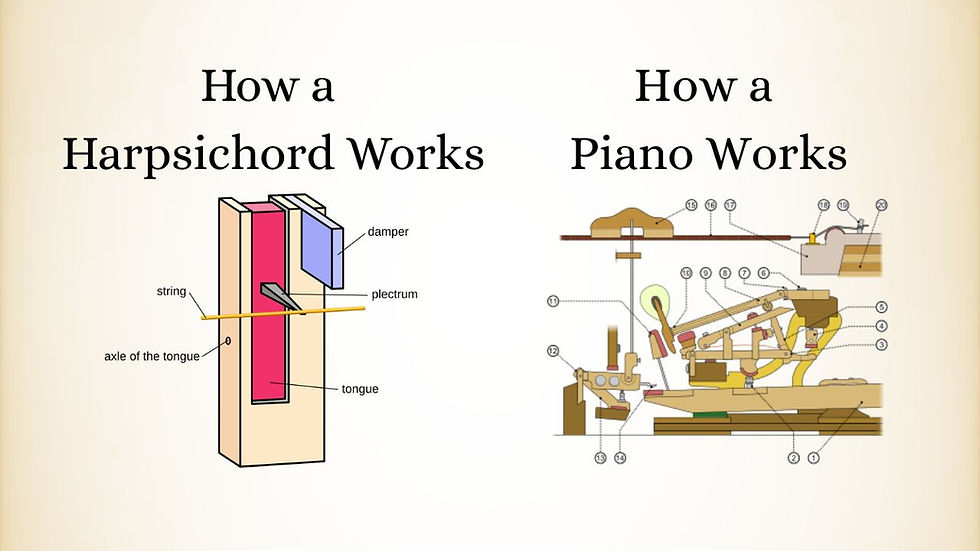
This is the big question! While they both have a keyboard and strings, the way they make sound is the key difference, and this affects what the musician can do.
Feature | Harpsichord | Piano |
Sound Action | Plectrum plucks the string | Hammer hits the string |
Volume Control | Cannot change the volume easily (always sounds the same loudness) | Can easily change the volume (soft to loud) |
Why? | The plucking action is the same no matter how hard you press the key | Pressing the key harder makes the hammer hit harder, creating a louder sound |
Nicknames | The "always loud" instrument | The "soft-loud" instrument (its original name was pianoforte) |
What the Harpsichord Could Not Do
The biggest thing a harpsichord could not do that a piano can is change its volume based on how hard the player presses the keys.
When a composer writes music, they use words like:
Piano (or p) which means soft
Forte (or f) which means loud
On a piano, the player can make a note soft or loud just by touching the key gently or strongly. This is called dynamics.
On a harpsichord, the volume stays roughly the same no matter how hard you press. The player can only change the volume in certain ways, like by pulling levers to use different sets of strings, but not instantly, note-by-note, like on a piano.
Listen to the Difference
To hear the beautiful sound of the harpsichord, listen to this Musette in D by J.S. Bach. There is a smaller version of this piece in Level 1 Achieve that you can hear below. The music downloads are included after the videos.
Musette played on a Harpsichord
Musette Played on a Piano
The Level 1 Version
Download the music
Level 1
Level 6
Conclusion
The harpsichord is a brilliant, historical instrument with a unique plucked sound. It was the star of the show for hundreds of years! However, the piano was a revolutionary invention because it gave musicians the ability to easily play both soft and loud sounds (the pianoforte), which the harpsichord could not do.
Test Your Harpsichord Knowledge (KS2)
1. What is the tiny part inside a harpsichord that plucks the string to make a sound?
A. Hammer
B. Bow
C. Plectrum
D. Finger
2. During which major period of music was the harpsichord the most important keyboard instrument?
A. Romantic
B. Modern
C. Baroque
D. Classical
3. What is the biggest difference between a harpsichord and a piano?
A. The piano is bigger.
B. The piano can easily change between soft and loud (dynamics), but the harpsichord cannot.
C. The harpsichord has a wooden case, and the piano has a metal case.
D. The harpsichord has more keys.
Glossary (Key Harpsichord Words)
Word | What It Means |
Baroque | A long time ago (around 1600-1750), when the harpsichord was most popular. |
Composer | A person who writes music. |
Dynamics | How soft or loud the music is. |
Forte (f) | A musical word meaning Loud. |
Pianoforte | The original, full name of the piano, meaning "soft-loud." |
Piano (p) | A musical word meaning Soft. |
Plectrum | The tiny part inside a harpsichord that plucks the string. |
Renaissance | An old time (around 1400-1600), when the harpsichord was first popular. |
Soundboard | The piece of wood that makes the sound loud enough to hear. |

